


Spotlight
Alice Bevan aims to transform endometriosis diagnosis
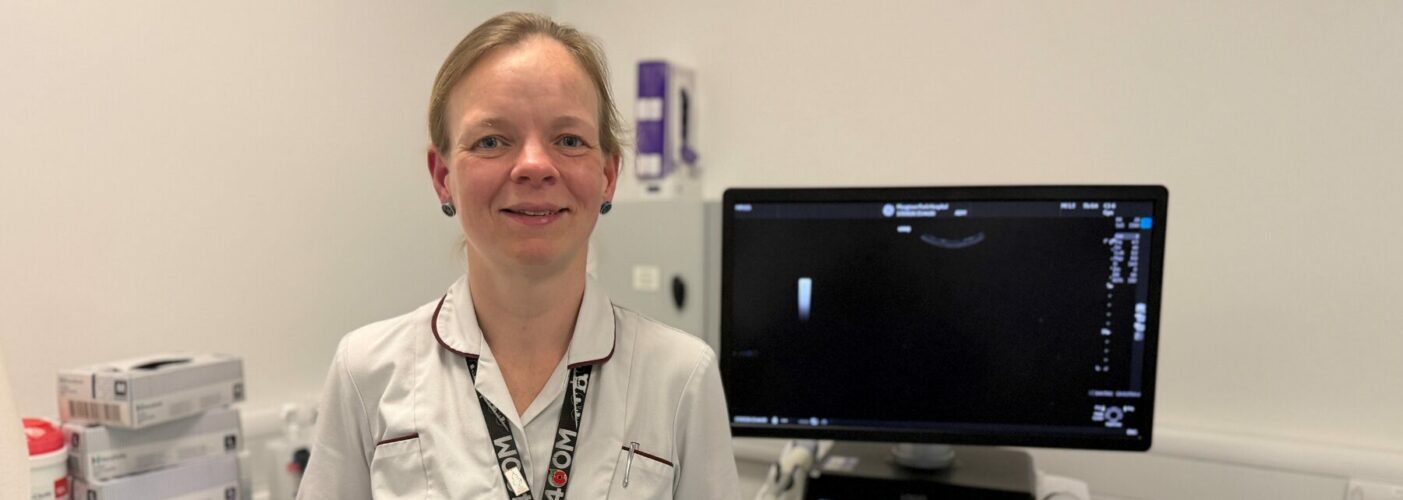
More women across Somerset could soon benefit from earlier, more accurate diagnosis of endometriosis thanks to an innovative piece of quality improvement work led by one of our sonographers, Alice Bevan.
Drawing on both her clinical experience and her advanced practice studies, Alice is working to embed a simple but powerful ultrasound technique into routine practice – and the potential impact for patients is significant.
Endometriosis affects around 10% of women, yet delays to diagnosis remain all too common.
Alice explains that one of the biggest challenges has been the historic belief that endometriosis can’t be seen on ultrasound. “The traditional wisdom was that we just couldn’t visualise it, but that’s no longer true,” she says.
“Modern equipment and advances in skills and research, especially from places like the United States, Canada and Australia, show us that we can see so much more than we used to think.”
Her project focuses on introducing and standardising a dynamic ultrasound assessment known as the uterine sliding sign, a manoeuvre that checks whether the uterus and surrounding organs move independently of each other.
“It’s incredibly simple,” Alice explains. “By applying gentle pressure during a transvaginal scan, we can see whether the organs glide naturally or move as one. If they’re stuck together, that can be a really strong indicator of endometriosis.”
Evidence suggests that around 80% of women with a ‘fixed’ or negative sliding sign go on to receive a diagnosis of endometriosis.
For Alice, that statistic represents a huge opportunity. “If we look for it routinely, we will find it –and we’ll find it earlier,” she says.
“Even picking up a handful of cases earlier can completely change someone’s experience, and potentially their whole life trajectory.”
At present, most routine pelvic ultrasounds focus mainly on the uterus and ovaries, meaning deeper signs of endometriosis may be missed simply because they’re not actively being looked for.
“What’s contributing to those long diagnostic delays is that people come back with normal scans, but only because nobody was assessing the parts of the pelvis where severe endometriosis tends to hide,” Alice says.
“We therefore we repeat tests, sending people back and forth, and we lose precious time.”
Alice’s quality improvement project, which is registered within our trust, aims to train all sonographers to perform and document the sliding sign as standard.
Alongside this, a smaller group of specialist sonographers will carry out more in‑depth scans for patients who need them, helping to reduce unnecessary investigations and fast‑track those who may require specialist care.
Alice is also weaving this into her advanced clinical practice Master’s project and playing an active role in the endometriosis multidisciplinary team.
“Being involved in the MDT has been incredible for my learning,” she says. “We’re correlating ultrasound, MRI and surgical findings, which helps us refine our skills and understand the full picture of each case.”
A study day for the sonography team is already being planned for June, which Alice will lead. “Teaching the sliding sign to the whole cohort is a huge part of this,” she says.
“We’ve got simulation equipment, case discussions, practical workshops, and we’re making sure the patient narrative sits right at the centre of it.”
Ultimately, her hope is that this work will cut down on unnecessary scans, avoid negative diagnostic laparoscopies, and reduce the emotional, physical and financial toll that delayed diagnosis can have.
“There are so many women whose symptoms affect every part of their lives, including their relationships, work, friendships, hobbies,” she says. “We have to do better for them. And while none of this is easy, it’s absolutely possible.”
And in even more positive news for women’s health services locally, the endometriosis centre at Musgrove Park Hospital has been awarded national accreditation for the third year in a row.
This recognition reflects the expertise, commitment and compassionate care given by the multidisciplinary team, and supports our trust’s ambition to provide the very best care for people with complex endometriosis.
Alice sees her work as a natural extension of that high‑quality care. “This is about strengthening the whole care pathway,” she says.
“If we can spot red flags sooner and refer people into the specialist service earlier, we can make a genuinely life‑changing difference.”
A huge thank you to Alice and everyone supporting this work. It’s a brilliant example of improvement driven directly by clinical curiosity, compassion and a determination to make things better for the people we care for.