


Spotlight
Test and learn in Frome, West Mendip and Bridgwater – 12-week evaluation
Last year the NHS in Somerset invested £1.6 million in intermediate care services to increase the availability of care provided in people’s own homes. We made temporary changes to how reablement is provided in Somerset and are testing their efficacy in a test and learn process.
The temporary changes that we made are:
- Expanding our Pathway 1 service to help people recover at home, extending this service to care for 83 (from 67) new people per week.
- Spot purchasing beds in care homes in Somerset so that people who need long-term 24-hour care can move directly from an acute hospital into a care home and will no longer need to move twice. Previously these patients would have gone to a community bed first. In addition, some changes were made to the commissioning of care home beds, moving to a spot purchase model, which the Council is leading on.
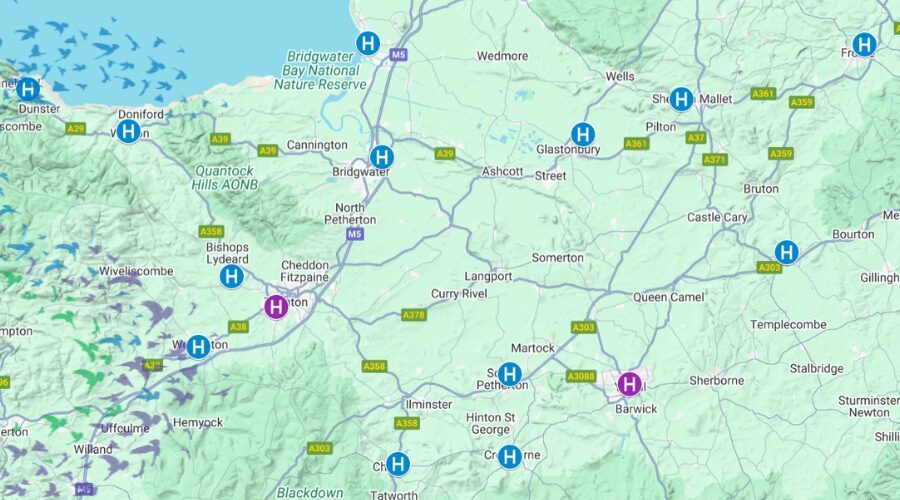
- Temporarily reducing the number of community hospital beds in three of our community hospitals.
- Bridgwater Community Hospital – 30 beds to 24 beds
- West Mendip Hospital in Glastonbury – 30 beds to 16 beds
- Frome Community Hospital – 24 beds to 16 beds.
These temporary changes enable patients in Somerset to receive intermediate care at home, or in a community hospital, or move directly to a long-term care home placement if they require 24-hour care.
We believe we can make real improvements and the outcome of the test and learn will tell us if that is so.
Implementation of the test and learn
These temporary changes were phased in from June and were in place from the end of September 2025.
The first 12 weeks of the test and learn ended on 22 December, and we are evaluating whether we have made improvements to patients’ access and outcomes by tracking metrics that include:
- The number of patients whose discharge from Yeovil District Hospital or Musgrove Park Hospital is delayed.
- The length of time that patients wait to access reablement at home, in a community hospital bed, or to access a long term care home placement if their needs have changed.
- Delays leaving either an acute or community hospital bed. We know that delays cause harm and prevent other people from being able to access beds.
- Patients’ length of stay in those community hospitals where temporary bed reductions are in place.
- A variety of patient outcomes depending on whether patients received reablement in their own homes or in a community hospital that includes the percentage who were discharged home, able to remain at home, the percentage that required care packages and the percentage that were readmitted to hospital.
- Community hospital occupancy broken down by Primary Care Network (PCN) to see whether the changes have resulted in people having to travel further to access a community hospital bed.
- Feedback from patients and colleagues.
A small proportion of data is outstanding and the rest is provided in the following evaluation after 12 weeks of the test and learn.
Evaluation of the test and learn after 12 weeks
1. No criteria to reside
Since the start of the test and learn until 22 December, we have seen a reduction the number of patients in an acute hospital in Somerset who’s discharge from hospital is delayed. This is a very important measure because we know that delays cause harm and they prevent other patients from receiving the care they need.
At the end of the 12-week evaluation period:
- The number of patients who are medically fit to be discharged from an acute hospital in Somerset, but who’s discharge is delayed, had reduced by 18%.
- The number of bed days lost as a result of delayed discharges had reduced by 28% from May (before any changes were phased in) to November (when the latest data is available).
- Somerset NHS Trust’s ranking for No Criteria to Reside (NCTR) performance had improved from 101 out of 118 trusts in England and 10th out of 13 trusts in the south west, to 79th in England and 6th in the south west.
2. Waits for reablement (Pathways 1 and 2) or for a long term care home placement
Because we know delays cause harm, we have monitored the time that patients wait for reablement in their own homes or in a community hospital bed, or for a long term care home placement if their needs have changed. Our aim is to reduce waits for reablement in the patient’s own home, and in a community hospital bed, to 2 days, and for a placement in a care home to 5 days.
At the end of the 12-week evaluation period, all waits had reduced although further work is needed to reduce these further.
- The average time people waited to access reablement in their own homes reduced from 4.4 days in September to 3 days in December.
- Average waiting times for patients discharged from Musgrove Park Hospital, Yeovil District Hospital and Royal United Hospital all reduced from September to December.
- In September, average waits for patients to be admitted from an acute hospital to a community hospital bed were 3.03 days for MPH, 2.71 days for YDH patients and 2.23 waits for RUH patients. In December, these waits had reduced to 2.24 days for MPH patients, 1.83 days for YDH patients and 2 days for RUH patients.
3. Effectiveness of reablement delivered at home (Pathway 1)
We are monitoring the effectiveness of reablement delivered in people’s own homes by monitoring the proportion who are able to remain in their own homes, the proportion who were readmitted to hospital, and by seeking feedback from patients and families.
The percentage of people who remained in their own homes after receiving reablement at home remained broadly the same during the 12-week evaluation period and was 84% in September and 86% in December. The percentage of patients who received reablement at home and were subsequently readmitted to hospital also remained almost the same at 13% in September and 14% in December.
We sought feedback from patients who are received their reablement at home, and their families, to understand their experience and whether receiving reablement at home met their needs and expectations.
Those we received feedback from expressed high levels of satisfaction with the support they received in their own homes. 25 people (patients or carers) provided feedback via a QR code questionnaire and 16 people gave feedback via a telephone conversation.
Via questionnaire:
- 100% of people reported that the service helped them to feel more confident at home.
- 100% of carers felt the service left them feeling able to continue to care for their loved ones.
- 96% felt they had achieved their reablement goals.
Via telephone:
- Carers were described as compassionate, professional, reliable, and supportive of confidence building.
- The home environment was overwhelmingly viewed as the preferred and most effective place to recover.
- Users reported improvements in mobility, strength, and wellbeing after returning home.
- Negatives experiences were isolated. Where these occurred, they related to care visit scheduling issues with inconsistent and/or long-time windows and occasional limited therapy access.
4. Effectiveness of reablement delivered in a community hospital bed (Pathway 2)
We are monitoring the effectiveness of reablement delivered in community hospital beds in Frome Community Hospital, West Mendip Community Hospital and Bridgwater Community Hospital and the effectiveness of our own processes by monitoring outcomes such as patients’ length of stay, delays leaving community hospital beds, and the percentage who were able to remain living in their own homes.
Our target length of stay for patients receiving reablement in Frome Community Hospital, West Mendip Community Hospital and Bridgwater Community Hospital is 30 days. At the end of the 12-week assessment period:
- There have been significant reductions in length of stay at Frome and West Mendip Community Hospitals.
- Frome Community Hospital nearly met the target, with an average length of stay of 30.7 days in December.
- West Mendip Community Hospital exceeded the target with an average length of stay of 27.5 days in December.
- However, further work is needed in Bridgwater Community Hospital where the average length of stay fluctuated and was 42.8 days in December, up from 30.2 days in November.
There has been a reduction in the number of patients whose discharge from a community hospital bed is delayed. At the start of the test and learn, 69 people were delayed leaving a community hospital bed. At the end of the 12-week evaluation period, this had reduced to 42 patients.
The percentage of patients who were able to remain in their own homes was 45.8% at the start of the test and learn in September, rose to over 50% in October and November, but reduced to 43.8% in December.
We are also monitoring the occupancy of Frome, West Mendip and Bridgwater Community Hospitals by Primary Care Network, and the community hospitals that people from Frome, West Mendip and Bridgwater are admitted to so that we can fully understand the effects of the temporary changes we have made on local availability of community hospital beds. This data up until the end of December has very recently been collated and we need to do more work to fully understand what it is telling us.
5. Long term care placements (Pathway 3)
Before we began the test and learn process, we did not have a good solution for patients who required a long term care home placement after being discharged from an acute hospital. They were transferred temporarily from an acute hospital to an intermediate care bed (community hospital or care home), stayed in this intermediate care bed for several weeks, often over 6 weeks, before undergoing another move into a long-term care home.
Our evaluation of the first 12 weeks of the test and learn shows that we are now providing a better solution for those patients. At week 12 of the test and learn:
- 59 people had completed their pathway 3 episode of care.
- On average this episode of care took 28.2 days, just above the target of 28 days.
- The majority of people accessing the pathway 3 service choose to stay in the same care home, preventing the need for multiple moves.
- As the new model is maturing, people are able to access pathway 3 beds more rapidly from an acute hospital, although we have not reached our target of five days.
Conclusions and next steps
Our 12-week evaluation of the temporary changes that we made to how reablement is provided in Somerset show improvements in some areas, and further work to do in others. So far, the data shows:
- Shorter harmful delays for patients leaving an acute hospital and accessing reablement in their own homes or in a community hospital.
- Shorter harmful delays for patients whose needs have changed and they require a long term care home placement, and fewer subsequent moves for them.
- Encouraging reductions in length of stay for patients receiving reablement in a community hospital, and a reduction in the number whose discharge from a community hospital is delayed.
The temporary changes we have made have not negatively impacted performance, but there are some areas where more work is required to make sustained improvements.
We also need to ensure that the improvements we have made are sustained over a longer period of time and under varying circumstances. We are therefore planning to extend the test and learn until the end of September 2026, so that it runs over 12 months. This will enable us to embed improvements, test the changes under varying conditions across a full calendar year, and gather more feedback.