

Spotlight
Bowel Cancer Screening Programme celebrates 20 years
A life-saving screening programme that has helped detect bowel cancer earlier for thousands of people is marking its 20th anniversary.
The NHS Bowel Cancer Screening Programme, launched in 2006, has transformed the way the disease is identified and treated, offering a simple home testing kit that can detect early signs of cancer before symptoms appear.
In Somerset, the programme has grown significantly over the past two decades, evolving from a small service into a wide, multi-disciplinary team supporting patients across the county.
At the beginning there were three screeners, and 370 procedures were undertaken in the first year.
Now we have 10 screeners, and 1,250 procedures were undertaken in the last year – reaching a total of over 13,500 procedures since the screening programme began.
Screening has found over 800 cancers, with 2,500 high risk polyps removed that would have potentially turned into cancers.
Today, people aged between 50 and 75 who are registered with a GP are automatically sent a home testing kit – known as a faecal immunochemical test (FIT) – every two years.
The test checks for small amounts of blood in a stool sample, which can be an early sign of bowel cancer.
If the test indicates further investigation is needed, patients are referred on to specialist teams for additional tests, including colonoscopy procedures, which can identify and remove polyps before they develop into cancer.
Ffion Davies, our lead specialist screening practitioner, says the programme plays a key role in catching bowel cancer earlier, when it is most treatable.
“Screening is about finding changes before people even notice symptoms,” she says. “The FIT kit gives us an early indication that something might not be right, and from there we can investigate further and, where needed, take action.
“The importance of early detection is clear as bowel cancer is one of the most common cancers in the UK, but outcomes are significantly better when it is found at an early stage, with survival rates much higher for patients diagnosed early.
Over the past 20 years, the programme has continued to adapt, with changes to testing methods, technology and eligibility helping to improve both access and patient experience.
Amanda Knight, programme manager for Somerset Bowel Cancer Screening, says the service has developed significantly since its early days.
“When the programme first began, it was much smaller and the home test was quite different,” she says.
“We’ve seen a lot of change over the years, from older types of testing to the FIT kits we use today, which are quicker and easier for people to complete at home.
“Expanding the eligible age range has also helped more people benefit from screening. The extension of the programme to include people from the age of 50 has made a real difference, as we’re able to pick up potential issues earlier for more patients.”
Behind the scenes, the programme relies on a wide network of colleagues working together to deliver the service, including specialist nurses, consultants, radiologists, pathologists and administrative teams.
“Although patients might only see one part of the pathway, there are lots of different teams involved,” Amanda says.
“It’s a real team effort, and that collaboration is what allows us to provide safe and effective care.”
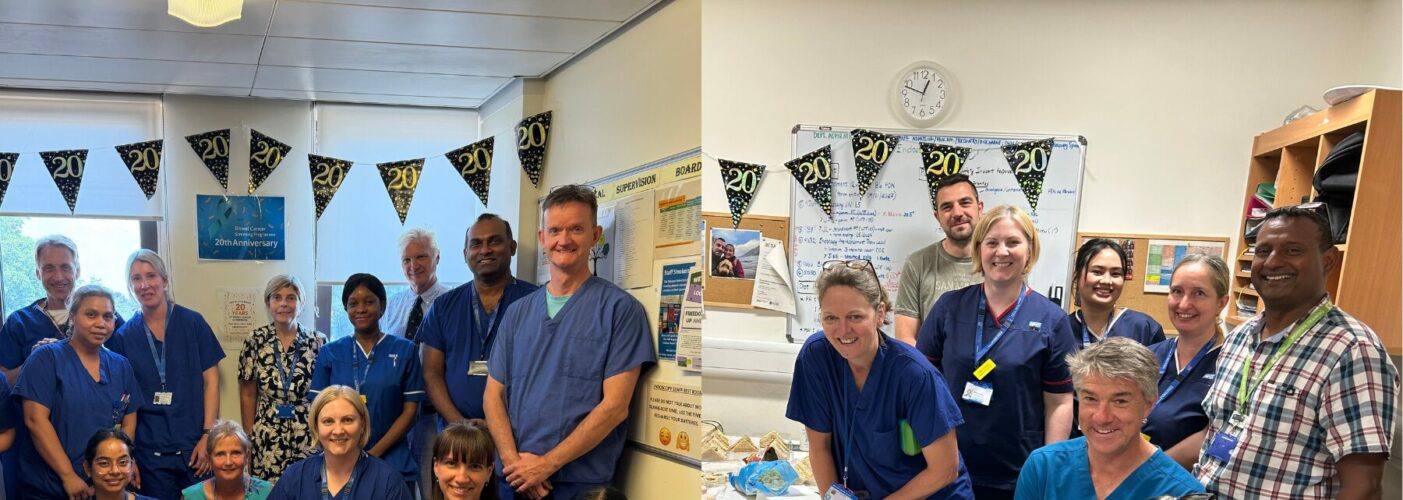
As the programme marks its 20th anniversary, the team is also taking the opportunity to recognise the contribution of colleagues who have been part of the service over many years and to thank those who continue to support it.
The team is dedicated to promoting the benefits of early detection through screening and regularly attend health events at workplaces, such as Hinkley Point C and Numatics.
The team also tries to improve uptake in groups such as farmers, armed forces and homeless by linking with the community hubs, established support groups and community events.
Looking ahead, there are plans to further enhance the programme, including changes to the FIT testing threshold to help identify even more cases at an earlier stage.
“The next step is reducing the threshold for the FIT kit,” Ffion says. “That means we will be able to detect more polyps and cancers earlier, which can improve outcomes and give patients a better prognosis.
“The change is expected to increase demand on the service, with preparations already underway to expand capacity and recruit additional colleagues.
“Despite the advances made over the past two decades, the key message for the public remains the same: taking part in screening is quick, simple and can make a real difference.
“We always encourage people to complete their FIT kit as soon as it arrives. It only takes a few minutes, but it could help identify something early and potentially save lives.”
She adds that screening is not a substitute for seeking medical advice if symptoms are present.
“If people notice any changes or symptoms, they shouldn’t wait for a screening kit – they should speak to their GP as soon as possible,” she says.
As the programme enters its third decade, colleagues say they are proud of how far it has come and the difference it continues to make for patients and communities across Somerset.
For them, the anniversary is not just a chance to reflect on past achievements, but an opportunity to reinforce a simple but important message: early detection matters, and screening plays a vital role in saving lives.
Dr Dan Pearl, centre director for the Somerset Bowel Cancer Screening Programme, says: “In 20 years of bowel cancer screening, thousands of lives have been changed, from early cancer detection and cure to cancer prevention through pre-cancerous polyp removal.
“Over this time, the reach of the bowel cancer screening programme has extended to involve younger adults and those with specific genetic risks, and to actively break down social, racial, economic, and educational barriers.
“A successful screening programme requires willing participants, Somerset has historically had some of the highest participation rates nationally which translates directly to lives saved.
“It has been my privilege to work with Somerset’s dedicated team of doctors, nurses and administrators who strive to provide this excellent service, of which we should be rightly proud.”
Dr Paul Thomas, who was the programme’s first clinical director, says: “It has been a privilege to be part of the Bowel Cancer Screening Programme as it enters its third decade.
“Since helping establish the Somerset programme in 2006 and serving as clinical director for 12 years, I’ve seen the service evolve significantly.
“Despite major changes, including age extensions and new screening methods, colleagues have continually delivered exceptional care, setting the standard for colonoscopy and saving thousands of lives. It shows the NHS and preventative healthcare at their very best.”
Dr Edd Cooper, our consultant cellular pathologist, adds: “Having been part of the Somerset Bowel Cancer Screening Programme since it began in 2006, and serving as lead pathologist until earlier this year, I feel enormously proud of what the team has achieved over the past 20 years.
“I have seen the service develop and continually improve, helping to detect bowel cancer earlier and prevent many cancers from developing in the first place.
“None of this would be possible without the dedication of our outstanding multidisciplinary team, from administrators and specialist screening nurses to gastroenterologists, pathologists, and support colleagues.
“It has been a privilege to work alongside such talented colleagues and to contribute to a programme that has had, and will continue to have, such a positive impact on the people of Somerset.”