

Spotlight
Trust launches innovative way of detecting oesophageal cancer earlier
Our trust has become one of the first in the country to launch a pioneering new case-finding project aimed at detecting oesophageal cancer at an early stage.
The initiative, which has launched already in Bridgwater, Chard and Langport, will see thousands of people across the county proactively contacted by text and invited to book a quick test that could catch cancer before symptoms even appear.
The trust has set up the project in partnership with C the Signs, an artificial intelligence platform that scans GP records to spot patients who meet specific clinical risk factors for oesophageal cancer.
Initial data suggests that around 3,000 people in Somerset may be at higher risk of oesophageal cancer and could be eligible for the capsule sponge test. So far, more than 1,900 patients have been contacted, with a positive response rate of 18%.
Encouragingly, nearly 350 people have already taken up the offer of testing. This has led to the early identification of oesophageal cancer in some patients, as well as the detection of Barrett’s oesophagus, a known precursor condition, enabling earlier intervention and ongoing monitoring.
The project began at Taunton Road Medical Centre in Bridgwater, and has been extended to all GP practices in the town, and is now being extended across Somerset.
Eligible patients identified by the system will receive a text message recommending that they book an appointment, and our cancer services team is urging people to trust the text message and follow the link.
Rosie Edgerley, our cancer programme manager, explains how the new approach works and why people who get the text message should book an appointment.
She explains: “We’ve started in Bridgwater and now we’re extending to all GP practices within the Somerset.
“We’re working with C the Signs – which uses artificial intelligence to identify patients at risk of cancer at the earliest stage – to run searches within patients’ GP records for those who meet certain risk factors, and then we text them a link to say we recommend that they complete a short assessment form to determine whether they need an appointment with us.”
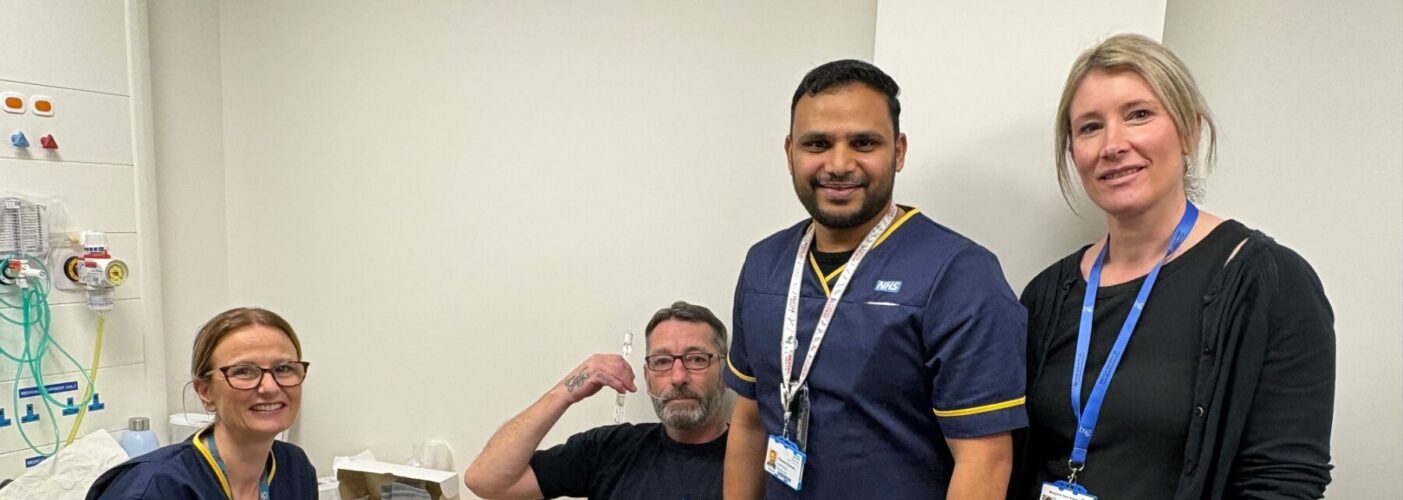
Once patients respond, the team reviews the information and, if the patient is eligible, they are invited to undergo a capsule sponge test – a quick, minimally invasive procedure that helps detect Barrett’s oesophagus, a condition that can increase the risk of developing oesophageal cancer.
Rosie continues: “If they’re eligible then they come in and have something called a capsule sponge, which is a small capsule that they swallow on a string.
“It sits in the stomach for seven minutes before opening into a little sponge, which is then pulled out, collecting cells from the oesophagus that go off to be analysed.
“Based on those results, it will determine the next steps. As these text messages will likely come to people out of the blue, we want them to trust it and follow the link to book an appointment.”
Our consultant gastroenterologist and clinical lead for the project, Dr Emma Wesley, explains why early detection is vital.
“Oesophageal cancer is increasing and we often tend to catch it at a late stage, so roughly only around one in four patients in Somerset are diagnosed at stage 1 or 2,” she says.
“By the time a person has symptoms, they’re more likely to be at stage 3 or 4, when treatment options are much less.
“It’s all about getting people earlier when they don’t have symptoms, or the symptoms they have are so minor they might not even notice.
“There are pre-cancerous changes in some people that can be treated to prevent cancer and if we catch the cancer early it has a high chance of being cured. Unfortunately, if the cancer presents late, it’s often fatal.”
The initiative supports the ambitions of the National Cancer Plan, which aims for 75% of patients diagnosed from 2035 to be cancer‑free or living well after five years.
Bridgwater was chosen as the starting point due to pockets of deprivation that increase the prevalence of risk factors such as smoking and obesity, but the team is now working to extend this across Somerset.
The town also benefits from having both a community diagnostic centre and an endoscopy unit at Bridgwater Hospital, enabling easy access to further testing when required.
Dr Wesley adds: “Not many NHS trusts have reached out to this group of patients in this way before, with a case‑finding and direct contact approach.
“It’s a bit like a filter test: if it’s negative, the patient is discharged from our care, but if it’s positive, they go on to have an endoscopy, and the urgency of that depends on what we find. If we message you, please engage by following the link.”