

Spotlight
Investment expands access to specialist airway equipment at Musgrove
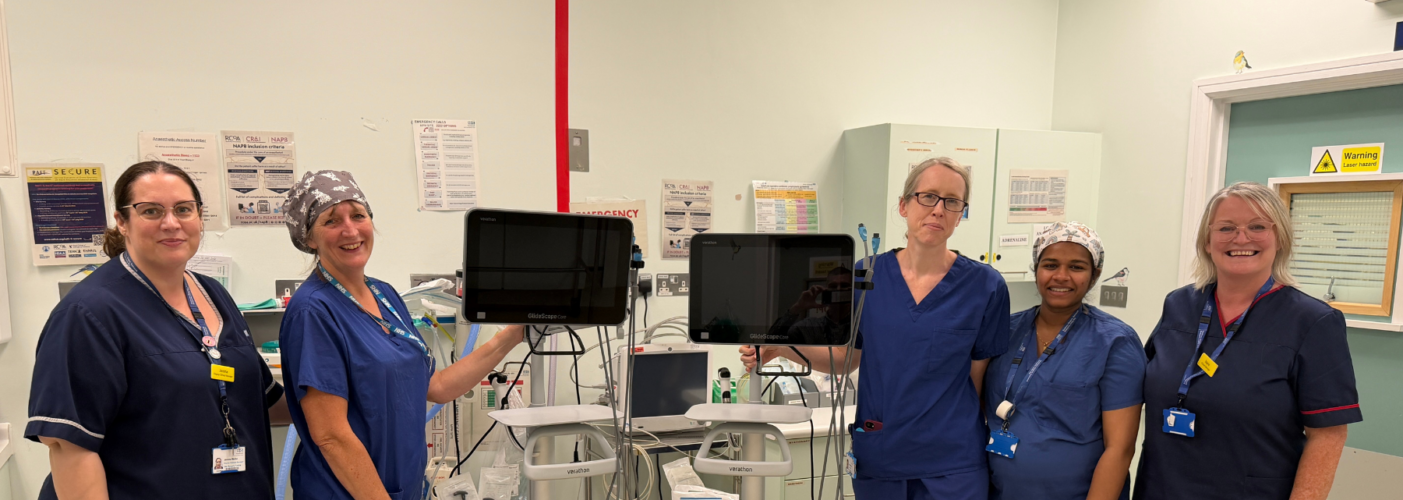
Patients undergoing surgery at Musgrove Park Hospital are set to benefit from enhanced safety as specialist airway equipment has been introduced into every operating theatre across the hospital.
The trust has invested in additional video laryngoscopes, which are devices used by anaesthetists when placing breathing tubes prior to surgery and other procedures requiring anaesthesia.
While the technology has been available in parts of the hospital for a number of years, every operating theatre now has access to the equipment, helping clinical teams respond more quickly and safely when managing a patient's airway. The technology is also available in Yeovil Hospital's operating theatres.
The change follows national guidance from the Difficult Airway Society that recommends video laryngoscopes as the first-choice equipment for intubation, a procedure where a tube is placed into a patient's airway to support breathing.
Dr Kate Reeve, a consultant anaesthetist and Musgrove Park Hospital’s airway lead, says: “We've always had one or two video laryngoscopes in each area of our operating theatres, but we've now introduced this into every single theatre across the hospital.
“To align with national guidance, we have not only invested in replacing our existing video laryngoscopes but have also purchased additional devices so that every theatre in the hospital is equipped with one.”
Research has shown video laryngoscopes can improve the success of first-time intubation attempts, reduce tissue damage and support safer airway management.
A key benefit of the investment is that important airway equipment is now available wherever anaesthesia takes place, rather than needing to be collected in an emergency.
Dr Reeve says: “We’re making a change so that difficult-airway equipment is readily available in every location where an anaesthetic is delivered.
“We are bringing all the essential safety equipment directly into the areas where anaesthesia takes place, removing the potential for delay if it must be retrieved from elsewhere during an emergency.”
The equipment will play an especially important role in the hospital's new surgical centre ensuring every operating theatre has immediate access to the same high-quality airway equipment regardless of location.
The new video laryngoscopes also improve communication between members of the theatre team by displaying a clear view of the airway on a large screen visible to everyone involved in the procedure.
“One of the biggest benefits is team communication,” adds Dr Reeve. “Our operating department practitioners, anaesthetic nurses, and other colleagues assisting can all see exactly what is happening with the airway. Ensuring that all members of the team can see the airway view in real time is a significant patient‑safety benefit.”
Marie Conway, our Day Surgery Centre theatres clinical manager, says: “It can be particularly challenging for operating department practitioners when they are unable to see what the anaesthetist can see during airway management.
“However, displaying the airway on a screen allows the entire team to visualise it simultaneously, enabling us to anticipate and prepare for the next steps in patient care as soon as the airway is identified.
“The project has also improved standardisation across the hospital's operating theatres, ensuring that the same airway trolley layout and equipment are available in every clinical area.
“This consistency supports safer practice, enhances team familiarity with equipment, and improves efficiency during routine and emergency situations."
Dr Reeve says: “Previously, the hospital had only one paediatric video laryngoscope. The new equipment is compatible with all paediatric sizes, representing a significant improvement in the quality and safety of airway care we can provide for children.
“In every theatre at Musgrove, the airway trolley and video laryngoscope are now standardised, so colleagues can rely on the same equipment wherever they are working.”
The approach was first trialled in the hospital's Day Surgery Centre before being extended across the wider theatre department.
Feedback from colleagues helped shape the final model, with changes made in response to suggestions from teams using the equipment every day.
Dr Reeve adds: “Overall, colleagues have responded positively to the change and greatly appreciate having the appropriate equipment readily available.”
Marie concludes: “I’m extremely proud of our anaesthetic operating department practitioners and anaesthetic nurses, who made this transition such a smooth and successful one through their willingness to embrace change, adapt their practice, and fully comply with the new processes.
“Their professionalism, commitment, and teamwork were instrumental in achieving this positive change.
“I would also like to give special recognition to Jemma Marke, our anaesthetic and recovery duty clinical manager, for her outstanding support to her colleagues throughout the implementation.
“Jemma played a key role in introducing the new equipment, establishing the required product codes, and ensuring effective stock replenishment, all of which contributed significantly to the success of the transition.”