

Spotlight
From roadside delivery to emergency care: Paramedic Matt shares his career journey
It’s not every day you deliver a baby on the side of the road, but paramedic Matt Ward did just that… on his way to his job interview at Musgrove Park Hospital!
More than two decades into his career as a paramedic, moments like that still capture exactly what he values most about the role – being there for people at some of the most important and challenging moments of their lives.
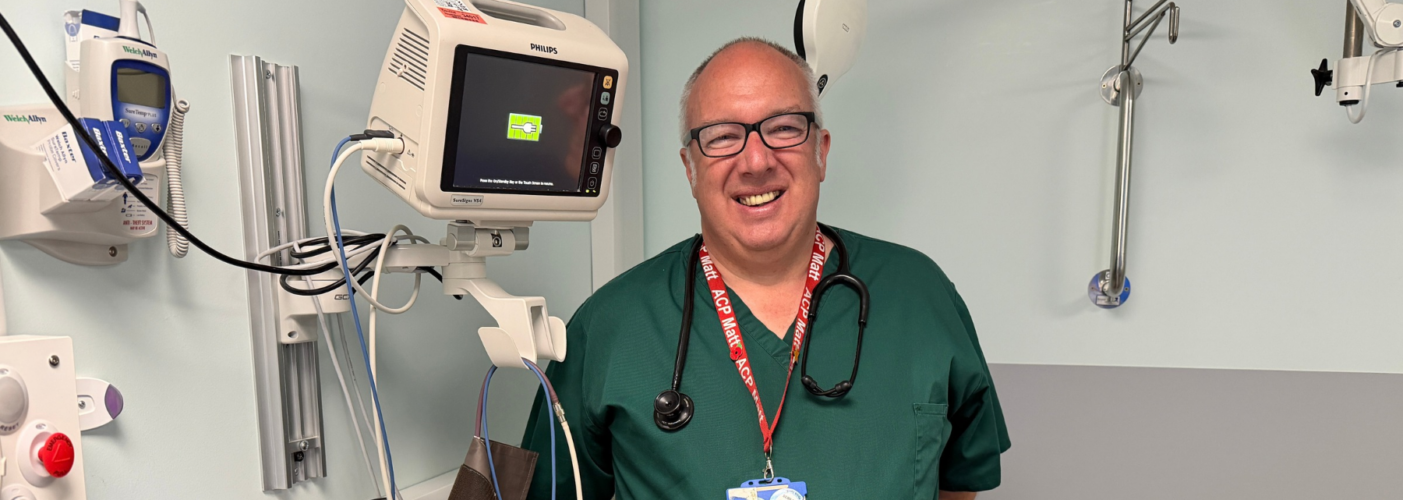
Now working as an advanced clinical practitioner and paramedic in our emergency department at Musgrove Park Hospital, Matt has built a varied career that spans frontline practice, education and national leadership.
But he said it all comes back to one thing, “Without the patient contact and care, none of the other things would motivate me,” he says.
“It’s all about helping people and caring for them at the most difficult times in their lives. Even if it’s bad news, it’s about doing that in a way that they feel looked after and supported.”
Matt’s journey into paramedicine began at a young age, volunteering with the British Red Cross from the age of 13 and gaining early experience in emergency care.
“I started doing first aid at events and also did some work experience in an emergency department,” he says.
“I carried on volunteering there and then eventually got a job, and I realised that it was something I really loved doing.”
Although he had originally set his sights on becoming a pilot, his experience in healthcare quickly changed his direction.
“I applied for both nursing and paramedic roles on the same day, not really knowing which way I’d go,” he continues. “I got a place as a student paramedic, and that was it.
“My decision was also influenced by family, with my father among the early generations of paramedics working in the UK. I’d grown up around the ambulance service, so it was something I’d always been aware of.”
Starting his career in the West Midlands in 2000, Matt spent many years working in pre-hospital care before branching out into a range of specialist and leadership roles.
Alongside his emergency department work, he is a consultant paramedic in pre-hospital care, contributes to national clinical guidelines and serves as a director of the British Association for Immediate Care.
He also teaches as a senior lecturer in advanced practice at Keele University, helping train the next generation of paramedics.
Despite the breadth of his work, he said the core of the profession has remained the same. “The most important thing for me has always been patient contact,” he says. “That’s what drew me into it, and that’s what’s kept me in it.”
One moment that stands out in his career came while travelling for a job interview at Musgrove Park Hospital.
“I was driving down from the Midlands and saw a car stopped on a dual carriageway,” he says. “When I got there, there was a woman in the back seat giving birth.
“I delivered the baby, handed them over to the ambulance crew when they arrived, stopped at the next services to wash my hands, and then carried on to my interview.”
Reflecting on his career, Matt says paramedicine has changed significantly over the years, with the role now extending far beyond traditional ambulance work.
“Paramedicine has come so far in a relatively short space of time,” he says. “It used to be associated almost entirely with the ambulance service, but now paramedics work right across the healthcare system.
“This evolution has opened up new opportunities for paramedics to develop advanced skills and take on different roles.
“We’ve seen really rapid development in areas like prescribing, which comes with a lot of responsibility.
“The profession has gained a lot of trust, including from the public, and that’s something we have to continue to build on.
"While the profession continues to evolve, its purpose remains unchanged. At the heart of it, it’s still about caring for people, and that’s what matters most."